Discuss the role of history within national identity. Refer to the case of Serbian national identity and its function within the Yugoslav Wars.
by Daniel Fihrer
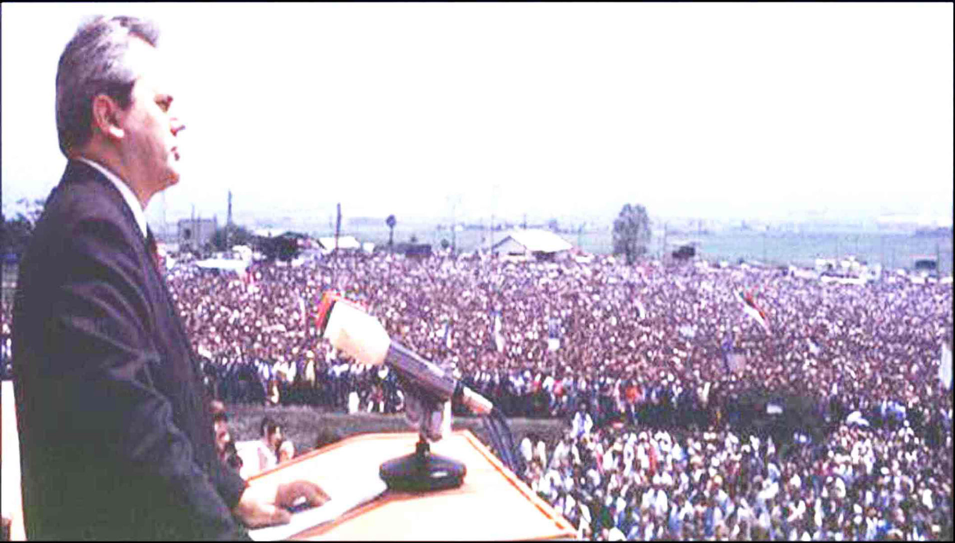
Ranke’s dictum, wie es eigentlich gewesen 1 disputes the mythologising capacity of history, 2 urging for a near-to-exact reproduction of the past. Difficulties regarding the function of history, as a mechanism by which historians produce a representation of the past, emerge within the complexities of Serbian national identity. National identity within Serbia presents historiographical challenges regarding the construction and role of history, especially within the context of the state. Serbian academic institutions as well as the media were responsible for an exhaustive abuse and weaponisation of history that promoted the brutal conflict and genocides of the Yugoslav Wars. 3 Through “dredg[ing] up and distort[ing]” “every conceivable event from Serbian history”, 4 the Serbian populace was propelled into an ethnic conflict upon historical foundations. The narrativization 5 of Serbia’s national identity allowed for an unsubstantiated and dramatic appropriation of historical events to inculcate xenophobia, hate, and fear. As expressed by John Lewis Gaddis, the “search for a past with which to attempt to control the future is inseparable from human nature” 6 which is deeply applicable to the Serbian case. This misuse of history for nationalist objectives often facilitates the enshrinement of “collective memories”. 7 These so-called memories cultivate dogmatic and powerful beliefs and sentiments which can extensively alter the course of a society. Ideally, history must aim to achieve “the widest possible definition of memory”, 8 preventing authoritative forms of national history. This process allows for the fallibility of memory to become secondary to the process of historical inquiry. Further, the danger of history being weaponised diminishes upon resisting the entanglement of ideology and history, democratising the field and preventing a “top down, state-sponsored project” symbolically “reading for the gaps”, 9 preventing a “top down, state-sponsored project” 10 The capacity for Serbia to embroil itself in a vicious conflict relied upon a nascent animus between ethnic groups, in parallel with a comprehensive exploitation by the elite of their constituents and historical events. Prior to the war, “surveys…revealed levels of prejudice and hostility among Croats, Serbs, and others that were actually less than those…in the United States.” 11 However, subdued tensions within the public did not preclude historiographical manipulation. Permeating “the dark storehouse of Serbian [collective] memory” 12 lay a trove of events that were manipulated to serve the politicised inflation of tensions, justifying the political call for Serbian hegemony. A central chord that defined Serbian national identity was the Kosovo Battle fought in 1389 between Serb and Ottoman forces in which Prince Lazar, a Serbian leader, through his self-sacrifice, became a Christlike martyr for the Serbian people. 13 This event was utilised as a form of self-victimisation which instigated a desire for the Serbians to “aveng[e] [their] savior’s death” in an “incomprehensible anachronism”, 14 which became the historical foundations to later be contorted. In 1989, on the 600th anniversary of the battle, Slobodan Milošević, the-then president of Serbia, delivered a speech to an estimated 1 million people, 15 in which he exclaimed that, “armed battles…cannot be excluded yet”. 16 This slyly was not overt in encouraging conflict, yet the underlying historical messages of his speech indirectly suggested otherwise. In the weeks prior, the remains of Lazar were toured around the country to throngs of people by the Serbian Orthodox Church leading Milošević to be “hailed as the reincarnation of Prince Lazar”. 17 He fed into a religious belief that Serbia was to be resurrected to its former glory and that it was once again necessary to “defend Christendom…against the [] Ottoman empire”. 18 The Serbian period under Ottoman rule from the 15th to the 19th century would also become a fundamental principle of Serbian collective identity. This epoch was incorporated into Serbian collective memory as a reminder of the consequences of being under another group’s ‘dominion’. Yet, the Serbs, within the Ottoman empire, “lived a life that…was not dissimilar from other subject peoples in other parts of Eastern Europe.” 19 Thus, to fully exploit this, the Serbs began “painting Bosniaks as the heirs of the Ottoman imperial power, intent on reimposing their dhimmitude 20 upon them…[and] that their Bosniak neighbours presented an existential threat.” 21 This came in reaction to a Bosnian appeal to declare independence from Yugoslavia, the country of which Serbia was also a part of. The exploitation of the memory of Ottoman rule fabricated a callous vision for the ethnic Serbians living in Bosnia of what the future could hold if Bosnia were to become independent. This promoted a fear within the Bosnian Serbs that was employed to catalyse hatred and violence. Through this process, how “Milosevic…allied himself permanently with the politics of fear” 22 to achieve his objectives. The enforced interplay between misconstrued history and hatred was also used with regard to “the events of WWII to successfully demonize Croats and Muslims in the eyes of the Serbs.” 23 The weaponisation of these events had been instilled such that the “epithet Ustashe 24 was used as often against Bosnian Muslims as against Croats” 25 , seemingly absurd labelling of the Serb’s adversaries. This was reliant on “ethnonational identity…continually [being] reformulated in an iterative process”, 26 whereby Serbians began a process of a “radical denial” of the Croatians, Bosnians and Serbians “belong[ing] to the exact same racial and linguistic group”. 27 Engaging in a process of ‘othering’ in conjunction with self-victimisation was promulgated as the media “poured out a constant stream of images showing the dismembered bodies of Serbs murdered by the Ustaša”. 28 The sustained adoption of victimhood as a method to advocate violence reflects the insidious effects that incubated collective memories can have when provoked within a national consciousness. The recognition that often “shared suffering unites more than [] joy”, 29 prompted politicians and institutional elite to exploit history whilst simultaneously perpetuating their nation’s historical grandeur and suffering. Interpretations of the gulf between memory and history are fluid, prompting concerns over the integration of memory into national identity. Pierre Nora, known for developing an understanding of the relationship between history and memory, expresses the shortcomings of memory as “unconscious of its successive deformations, vulnerable to manipulation and appropriation, susceptible to being long dormant and periodically revived”. 30 The significance of these flaws presents serious impediments to the scientific framework of the Rankean pursuit, ensuing from the synthesis of memory and history. Although Maurice Halbwachs, a maj or figure in the field of collective memory, and Nora attempted to demarcate between memory and history to validate the search for historical truths, there remains a “close interrelationship between history, collective memory and myth”. 31 Consequently, evaluating history and myth poses more pronounced challenges, especially within a nation. National identity in Serbia called upon collective memory to “provide a sense of identity and a sense of direction”. 32 The search for a past of torment interpolated Serbian history with a ‘victim complex’, rationalising violence with grievances over amplified subjugation. The media perverted history with “absurd and exaggerated interpretations of past relations between Serbs and non-Serbs”, 33 upholding newfound hatreds. This represented a process whereby “everything in the past that contradicted the required self-image [was] suppressed”, 34 allowing for the construction of a uniform and assertive national identity. Homogeneity within collective memory is vital in the fashioning of an unambiguous history and identity, frequently a prerequisite for a nation. Thus, although intertwined with memory itself, “historical studies often pose[] a threat to nationality” 35 through presenting the gaps within national identity. Although not compelled, this capacity presupposes the historian considers the “lacunae of national memory”. 36 Thereby, the historian “creates a countermemory”, 37 diverging from the inflexibility of collective memory, stimulating a reevaluation of national identity. The value in presenting contrary accounts to accepted histories derives from how “political judgements are permeated by a sense of the past” 38 [being] among the most fanatical champions of ethnic cleansing and genocide.” 39 Accordingly, the historian takes on the burden of reproducing the memories that may be uncomfortable or contrary to the nation’s identity.
The formation of national identity upon historical underpinnings produces an historiographical nationalism, in which the politicisation of identity leads to harmful consequences. Historically, a nation has relied upon “a heroic past with great men and glory”, this being the “social capital upon with the national idea rests.” 40 The ‘greatness’ of a nation’s history allows for the passage of a shared national identity intergenerationally. In Serbia, this occurred through the transfer of cultural literature, songs, and poetry, 41 breeding the unity indispensable to a nation. The present form of the nation has been cultivated to require a definitive historical identity, through contriving narratives which disregard geographic and social junctures. This use of historiography grants the citizens of a nation the ability to
conceive of “the image of their communion” 42 with their fellow citizens, which is critical due to the necessity of connecting millions of people through a historicised narrative. The solidarity and pride that historiographical nationalism prompts were reflected in Milošević’s 1989 speech, unifying a people at the expense of historical scholarship, demonstrating that for a nation “the ancient matters only when ideologically reinterpreted into the modern ideal of the nation-state.” 43 On the other hand, instrumentalist and constructivist 44 analyses of national identity refrain from accepting the tenets of historiographical nationalism, rather investigating the mythologising and invention that characterise nationhood. Constructivist, Benedict Anderson, posits that historiographical nationalism is severely untenable and thus a nation should be considered as an “imagined political community”. 45 The uniformity of the nation has also been challenged through comparativist approaches, outlined by founder of the Annales School, Marc Bloch, who argues for a “conciliatory role of history [to] bring different nations together”. 46 The field of comparative history aims for the dissolution of preconceptions of nations and the “lines drawn on the map [which] have no prenatal existence”. 47 By revealing the inadequacies of a popular national history, a more holistic, transnational representation of history can be achieved. Further, objections to historiographical nationalism have arisen from approaches related to ‘history from below’. Otherwise known as ‘people’s history’, its associated methodologies have democratised the field, opening accepted national histories to review and thus, achieving “a break with the nationalist paradigm.” 48 As a result, historiographical nationalism, being the primary structure for conceptualising national identity, faces alternative historical approaches which redefine the central precepts of the nation.
The expression of national identity often aligns with the arc of a narrative, emulating wider concerns over the narrativization of history. The structure of a narrative aptly complies with human sensibilities, being “a mode of verbal representation that is so seemingly natural to human consciousness”. 49 However, due to its formulaic and palatable nature, it suggests that “its use in [history which] aspir[es] to the status of a science must be suspect.” 50 Applying a ‘narrative-esque’ structure to history requires alteration, through necessitating the adjustment of evidence found, to the prescriptions of a narrative. This presents a problem when “sometimes there is no possible distinction between a “monumental” past and a mythical romance,” 51 allowing for adaptations suiting a political narrative. Further, the politicisation of history results in “ideology shap[ing] narrative”, 52 meaning that the historical inquiry is subverted in its endeavour for accurate representation. Although objectivity is not wholly viable, the narrative structure and the resultant mythmaking mean that “regardless of the veracity of the national myth, it will serve serious symbolic meaning in regard to the identity of a nation”. 53 The effect of the narrative was epitomised in the Yugoslav Wars, with the War being typified by its “pseudo-romantic and mythologizing ethnocentrism, whose corollary is the demand for ethnic homogeneity within a centralized and militarily powerful state.” 54 This was ultimately clear in a 1986 draft memorandum from the Serbian Academy of Arts and
Sciences (SANU), perpetuating a perverted historical narrative that “Serbs in Yugoslavia were victims of discrimination…economic and political oppression…[and] at risk of genocide”. 55 The SANU memorandum’s “raw nationalism and the sheer scale of its fabrications stunned the people of Yugoslavia”. 56 Milošević would later adopt the principles outlined in the memorandum, with it becoming a force for “aggressive national aggrandizement”, 57 a demonstration of the power that a politicised narrative could have. Hayden White who is often considered to be a postmodernist, in his seminal work Metahistory, suggests that “the historical work…is…a verbal structure in the form of a narrative prose discourse that purports to be a model, or icon of past structures”. 58 His assertion that history is a “model, or icon” of the past reveals the belief that narrativization lends itself to the modification of history to suit a literary style, thus disputing the Rankeaninspired search for objectivity. However, the narrative structure is not “so fluid in meaning as to be incapable of conveying any definitive knowledge.” 59 Therefore, a balance must be found in the narrativization of history, especially within the context of national identity. Through prioritising content over form and resisting the emmeshing of ideology and the narrative, the historian can maintain their focus on the historical process and evidence. Thereby, the historian can more efficaciously thwart the misrepresentation of history and the issues underlying the narrativization of history within national identity.
In conclusion, national identity is grounded in a process of mythologising, narrativizing and remembering. The process of uprooting national identity from these central processes requires a shift in history’s approaches towards the resultant complexities. The individuals of a nation “have a great deal in common and also…have forgotten many things” 60 and consequently, it is the historian’s responsibility to remind them of their past, disrupting the common narrative. Within Serbia, this duty was not realised with historians seeing “no contradiction between the tenets of their profession and the writing of self-serving national histories”. 61 This failure in not appreciating the conflict between their construction of a popular history and their historical, procedural assurances, allowed for history to be weaponised to substantiate political aims. Undoubtedly, “history is forged into a weapon in the crucible of politics” 62 the inclusion of ideology within the writing of history. Disentangling ideology and history requires the historian to not shape historical evidence to conform to a narrative structure. Although the narrative is central to human sensitivities, identifying its limitations and accentuating the evidence supports a more accurate representation of the past. Furthermore, particular to national identity is the fusion of collective memory into the national consciousness. This practice introduces the pitfalls of memory into historical inquiry which was essential to the misrepresentations that defined Serbia’s conception of their history.
Therefore, the historian takes on a supplementary role when appraising the historiography of a nation, this being to search for the gaps within national identity. Unearthing these gaps is crucial, especially within a powerful national identity, as “with the passage of time, [historical] representations become reality in the sense that they…eventually replace altogether the firsthand memories people have”. 63 The considerable influence that history can have upon a society was unequivocally apparent within the case of Serbian national identity, revealing the need for change in the relationship between history and the nation. E.H. Carr expressed that “To enable man to understand the society of the past, and to increase his mastery over the society of the present, is the dual function of history.” 64 Thus, the historian must endeavour to achieve an accurate and total representation of the past to ensure this process is not weaponised. Concludingly, this will allow for an integration of history into national identity which does not yield adverse consequences such as in the case of Serbia.
- *Ranke 1824, p.7. ; Recognised for his contributions to the discipline of history through his implementation of
source-based research, Ranke’s statement reflects his belief in the value of showing “how things actually were”
and the imperatives of empiricism and objectivity. ↩︎ - Berger 2009, p.490 ↩︎
- A set of conflicts that occurred in Yugoslavia which lasted from 1991 to 2001, resulting in the deaths of over
100, 000 people, extreme economic tolls and the breakup of Yugoslavia. ↩︎ - Bennett 1995.* ↩︎
- Meaning to communicate something with a narrative-like structure. ↩︎
- Gaddis 2002, p.147. ↩︎
- MacMillan 2009, p.81. ↩︎
- Tosh 2000, p.2. ↩︎
- Churchwell S. in Carr H. & Lipscomb S 2021, p.69. ↩︎
- Little 2019. ↩︎
- Mann 2005, p.360. ↩︎
- Boose 2002, p.75. ↩︎
- The Battle of Kosovo was fought between Serbian forces and an invading Ottoman force. Although evidence
is scant, Serbian myth heralds, through folklore, that Lazar was betrayed by Lord Vuk Branković, invoking a
biblical reference to Judas. Further, the subsequently developed ‘Kosovo Myth’, claims that the Battle was the
downfall of Serbia which is not widely accepted. ↩︎ - Boose, p.75. ↩︎
- Milošević 1989. ↩︎
- Ibid. ↩︎
- Branson and Doder 1999. ↩︎
- Little. ↩︎
- Judah 1997, p.28. ↩︎
- A dhimmi refers to a non-Muslim living in an Islamic state. ↩︎
- Karčic 2022, p.22. ↩︎
- Djilas 1993, p.93. ↩︎
- Majstorovic 1997, p.175. ↩︎
- The Ustaše (or Ustaša/Ustashe) were a Croatian Fascist movement that were responsible for the extermination
of hundreds of thousands of Serbians during WWII. ↩︎ - Boose, p.77. ↩︎
- Majstrorovic, p.171. ↩︎
- Boose, p.76. ↩︎
- Karčić, p.13. ↩︎
- Renan 1882. ↩︎
- Nora 1989, p.8. ↩︎
- Berger, p.492. ↩︎
- Tosh, p.1. ↩︎
- Bennett. ↩︎
- Tosh, p.11. ↩︎
- Renan. ↩︎
- Assamann 2008, p.63. ↩︎
- A counter-memory refers to the concept of resisting the established version of an history. ; Ibid, p.63. ↩︎
- Tosh, p.1. ↩︎
- Berger 2007. ↩︎
- Renan. ↩︎
- Pawlikowski 1992. ↩︎
- Anderson 2006, p.6. ↩︎
- Mann, p.361. ↩︎
- Instrumentalism and constructivism are two approaches to understanding ethnic and national identity.
Instrumentalism suggests that these forms of identity are tools that can be mobilised by groups for a larger
purpose whilst constructivism suggests that they are constructed by social forces. ↩︎ - Anderson, p.6. ↩︎
- Bloch 1928, p.521. ↩︎
- Ibid, p.517. ↩︎
- Bhattacharya 1983, p.7. ↩︎
- White 1984, p.1. ↩︎
- Ibid, p.1. ↩︎
- Nietzsche 1957, p.15. ↩︎
- Hughes-Warrington 2022, p.4. ↩︎
- Pace 2022. ↩︎
- Djilas, p.92. ↩︎
- Karčić, p.10. ↩︎
- Ibid, p.10. ↩︎
- Banac 1992, p.1102. ↩︎
- White 1973, p.2. ↩︎
- Munslow 1997, p.60. ↩︎
Bibliography
Anderson, B. 2006. Imagined Communities. London: Verso.
Assmann, A. 2008. “Transformations between History and Memory.” Collective Memory and Collective Identity 75, no. 1 (Spring): 49-72. https://www.jstor.org/stable/40972052.
Banac, I. 1992. “Yugoslavia.” The American Historical Review 97, no. 4 (October): 1084-1104.
https://doi.org/10.2307/2165494.
BBC. 2016. Balkans War: a brief guide. https://www.bbc.com/news/world-europe-17632399.
Bennett, C. 1995. How yugoslavia’s destroyers harnessed the media.
https://www.pbs.org/wgbh/pages/frontline/shows/karadzic/bosnia/media.html.
Berger, S. 2007. History and national identity: why they should remain divorced.
https://www.historyandpolicy.org/policy-papers/papers/history-and-national-identity-why-they-should-remaindivorced.
Berger, S. 2009. “On the Role of Myths and History in the Construction of National Identity in Modern Europe.” European History Quarterly 39, no. 3 (June): 490-502
https://www.researchgate.net/publication/238431550_On_the_Role_of_Myths_and_History_in_the_Construction_of_National_Identity_in_Modern_Europe.
Bhattacharya, S. 1983. “’History from Below’.” Social Scientist 11, no. 4 (April): 3-20. https://www.jstor.org/stable/3517020.
Bloch, M. 1928. “Toward a Comparative History of European Societies.” In Enterprise and Secular Change: Readings in Economic History, edited by Lane, F. and Riemersma, J., 494-521. Illinois: Richard D. Irwin.
Branson, L, and Doder, D. 1999. “Introduction.” In Milosevic: Portrait of a Tyrant, 1-10. New York: Free Press.
Britannica. 2015. Ustaša. https://www.britannica.com/topic/Ustasa.
Boose, L. 2002. “Crossing the River Drina: Bosnian Rape Camps, Turkish Impalement, and Serb Cultural Memory.” Signs 28, no. 1 (Autumn): 71-96 https://www.jstor.org/stable/10.1086/340921.
Carr, E. 1961. What Is History? Melbourne: Penguin.
Carr, H, and Lipscomb, S, eds. 2021. What is History, Now?: How the past and present speak to each other”. London: Weidenfeld & Nicolson.
Djilas, A. 1993. “A Profile of Slobodan Milošević.” Foreign Affairs 72, no. 3 (Summer): 81-96
https://www.jstor.org/stable/20045624.
Foucault, M. 1977. Language, Counter-Memory, Practice. Translated by Bouchard D., and Simon S. New York: Cornell University Press
Gaddis, J. 2002. The Landscape of History. New York City: Oxford.
Gagnon Jr, V. 1995. “Ethnic Nationalism and International Conflict.” International Security 19, no. 3 (Winter): 130-166. https://www.jstor.org/stable/2539081.
Hughes-Warrington, M. 2000. Fifty Key Thinkers on History. London: Routledge.
Hughes-Warrington, M and Martin, A. 2022. Big and Little Histories: Sizing Up Ethics in Historiography. New York City: Routledge.
Judah, T. 1997. “The Serbs: The Sweet and Rotten Smell of History.” Daedalus 126, no. 3 (Summer): 23-45 https://www.jstor.org/stable/20027440.
Karčić, H. 2022. “History of Ethnic Relations in Bosnia and Herzegovina.” In Torture, Humiliate, Kill: Inside the Bosnian Serb Camp System, 10-29. Michigan: University of Michigan Press.
Križan, M. 1994. “New Serbian Nationalism and the Third Balkan War.” Studies in Eastern European Thought 46, no. 1 (June): 47-68. https://www.jstor.org/stable/20099532.
Lampe, J. 2022. Bosnian War: European History. https://www.britannica.com/event/Bosnian-War
Little, A. 2019. “A History of Hate – Bosnia: The Weaponisation of History.” Seriously…. Aired on June 11, 2019, 15:22 min. https://www.bbc.co.uk/programmes/p07crgn3.
Llobera, J. 1995. “Halbwachs, Nora and “history” versus “collective memory”: a research note.” Durkheimian Studies 1, no. 1: 35-44. https://www.jstor.org/stable/44708512.
MacMillan, M. 2009. The Uses and Abuses of History. London: Profile Books.
Majstorovic, S. 1997. “Ancient hatreds or Elite Manipulation: MEMORY AND POLITICS IN THE FORMER
YUGOSLAVIA.” World Affairs 159, no. 4 (Spring): 170-182. http://www.jstor.org/stable/20672499.
Mann, M. 2005. The Dark Side of Democracy: Explaining Ethnic Cleansing. 2nd ed. New York: Cambridge University Press.
Milošević, S. 1989. “St. Vitus Day Speech”. Transcript of speech delivered at Gazimestan, Kosovo, June 28, 1989. http://www.slobodan-milosevic.org/spch-kosovo1989.htm.
Munslow, A. 1997. Deconstructing History. Oxford: Routledge. New World Encyclopedia. 2022. Dhimmi. https://www.newworldencyclopedia.org/entry/Dhimmi.
Nietzsche, F. 1957. The Use and Abuse of History. Translated by A. Collins. Indianapolis: The Bobbs-Merrill Company.
Nora, P. 1989. “Between Memory and History: Les Lieux de Mémoire.” Representations 26, no. 1 (Spring): 7-24. https://www.jstor.org/stable/2928520.
Oncioiu, D. 2016. “Ethnic Nationalism and Genocide Constructing “the Other” in Romania and Serbia.” In Genocide, edited by Ugur Ümit Üngör, 27-47. Amsterdam: Amsterdam University Press.
Pace, T. 2022. Reconstructing History: The National Myth. https://www.byarcadia.org/post/the-national-myth.
Pavković, A. 1994. “The Serb National Idea: A Revival 1986-92.” The Slavonic and East European Review 72, no. 3 (July): 440-455 https://www.jstor.org/stable/4211551.
Pawlikowski, P. 1992. “Serbian Epics.” Uploaded in 2018. Vimeo video. 41:38 min. https://vimeo.com/308405461.
Ranke, L. 1885. The History of the Latin and Teutonic Nations. Leipzig: Duncker & Humblot
Renan, E. 1882. What is a Nation? Lecture given at the Sorbonne, March 11, 1882. Paris: Presses-Pocket.
Tosh, J. 2000. The Pursuit of History. London: Pearson Education.
White, H. 1973. Metahistory: The Historical Imagination in Nineteenth-Century Europe. Baltimore: The Johns Hopkins University Press.
White, H. 1984. “The Question of Narrative in Contemporary Historical Theory.” History and Theory 23, no. 1 (February): 1-3 https://www.jstor.org/stable/2504969.
Yeghiazaryan, L. 2018. “Which of the three main ethnic conflicts theories best explains the Ethnic violences in the postsoviet states of Azerbaijan, Georgia and Moldova?” Undergraduate Journal of Political Science 3, no. 1 (Spring): 46-64. https://www.cpp.edu/class/political-science/participate/undergraduatejournal/vol3/yeghiazaryan-3.pdf.
 moriahcollegeblog.com