Written by Mira Hasofer, College Principal
This past Pesach, my family and I had the privilege of being in Israel, a nation marked by a sombre atmosphere and also defined by persistent displays of hope and resilience. Our experience was humbling, opening our eyes to what our brothers and sisters in Israel live through each day, and providing us with invaluable learnings on the strength of togetherness.
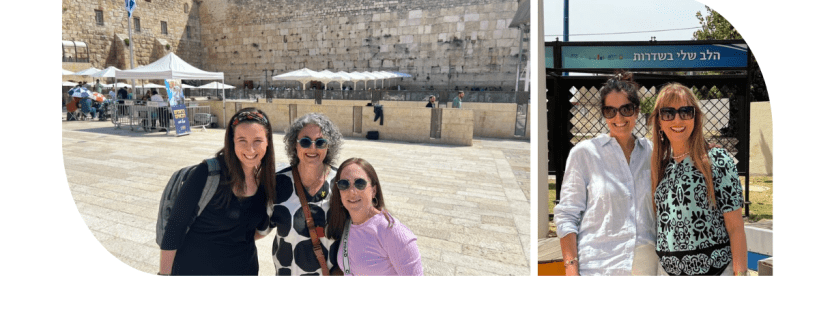
Two experiences stand out as reflections of Israel’s unwavering spirit. First, a day with a close colleague, a Principal in the southern city of Sderot named Dina Huri (pictured with me, above). She toured me through her school, where the remnants of rocket impacts are still visible on the playground. Despite the heavy toll on the community, she described how her staff work tirelessly to care for the students, including two young siblings who recently lost their father, a police officer, on October 7. At the local community centre, she introduced me to the children joyfully engaging in arts and crafts, face painting and singing the festive Pesach songs with their parents. When I asked where she finds the strength to continue each day, she answered, almost as an afterthought, “We rise to the occasion. We work together.”
The second experience was our visit to the Hadassah Rehabilitation Center, a building mid-construction, originally set to open at the end of 2025. Our guide, resolute and determined, explained how on October 7, the team received the directive to make the facility operational within two weeks. What followed was nothing short of extraordinary: builders, architects, plumbers, electricians, and volunteers worked around the clock to transform the site into a 200-bed emergency facility which could treat mass-casualties, military and civilian. Our guide was visibly moved as she recounted what had been achieved in two weeks. She said, “This is what we do—we work together to make things happen.”
A common thread connects these two experiences: a shared determination to collaborate and build. As we embark on Term 2, our message to our students is clear: we are always stronger together. By uniting our efforts and supporting each other, we can achieve both our individual aspirations and our collective goals.
This spirit of collaboration and mutual support is also evident in the recent journey of three of our teachers, Talya Wiseman, Mimi Nussbaum, and Nicky Segerman who represented Moriah College on the Y2i, Makom, Jewish Agency Jewish Educators’ visit to Israel. The experience was designed to inform Australian Jewish educators about the changed landscape in Israel post October 7, to inform curriculum, to develop the IST program, and to communicate key learnings and shifts that have taken place in the field of Israel studies since October 7. They share personal reflections and learnings, returning with a renewed commitment to enhance our students’ understanding and ability to speak about Israel and the Jewish world.

Reframing our Jewish Story
Written by Mimi Nussbaum, Head of Jewish Studies (High School)
אני אינני, מי שחלמתי
Hanan Ben Ari – עטלף עיוור
מי שדמיינת, פקחתי עיניים
והפכתי לאט
“I’m not the person that I dreamed,
(Or) who you imagined…
I opened my eyes
and changed slowly…”
I have come to understand that tragedy should not define our collective Jewish history, nor should the devastations we have experienced echo in the annals of our historical recount. Rather, it is the response to such tragedy that tells our story. Our real narrative should not be conveyed as one of expulsions, persecution and exiles; but the way in which our Jewish values propel us into the future.
It is such a powerful concept; that we have the ability to determine the way in which we not only memorialise the past, but also the way in which we thrive in the present, and dream about the future. As educators, with this ability comes an enormous and far-reaching responsibility, to educate our youth on the absolutism of right and wrong, challenging the moral relativism that so destructively pervades our world. It is our mission to teach about our identity as a Jewish people – inheritors of an ancient homeland that at once connects us to each other, Hashem and the Torah, overriding the constraints of time and political agendas. Yet the question that was so viscerally dialogued amongst the variety of educators, public figures, politicians, and everyday heroes we encountered was – what is our story? Who are we? What actually defines us as “us”?
And whilst there is no monolith of “the Jew,” the overarching message that has been so wholeheartedly reinforced throughout our experience, is the absolute imperative to teach the story of the Jewish people, from the very beginning. Our indigeneity to the land is one that is thousands of years old, first established in the brit between Hashem and Avraham and his descendants; heralding not only the place of monotheism in the world, but also the reciprocal relationship between Hashem and His people; whereby our responsibility to keep Torah and mitzvot, is bound by His promise to make us a people, and inheritors of the Land of Israel. This message has not changed; in fact, to this day, we still face towards Jerusalem three times daily; demonstrating the inherent longing for Zion that is so integral to our collective Jewish identity.
In addition to teaching that our rootedness to the land is not defined by modern political developments in the region, or UN declared borders, or even borders we have died for in modern wars; it is our absolute encumbrance to educate our students in the knowledge of “being Jewish”– our rituals, practices, history, liturgy, texts, and values – all the elements that distinguish us as a people, with a purpose; a people who are partners in creating a world that we are proud to call ours. One that we will incessantly defend; thereby establishing ourselves as bastions of goodness and hope, in a world so devastatingly lacking moral clarity.
And so I quoted the words of Israeli artist Hanan Ben Ari – because to me it is so clear that change has so eloquently spread its wings not only over the conscience and congruence of Israeli society; but undoubtedly the ways in which we interpret our own sense of self, as Jews. October 7 did not just shake to the core the soul of Israeli society, but it awakened in the consciousness of the Jewish people the world over, the burning desire to re-establish our narrative; in a way that is true and authentic to our experience, guided by the glimmering perpetuity and astuteness of our Jewish story.
Our hope is not lost
Written by Talya Wiseman, Head of Jewish Life (High School)
עוֹד לֹא אָבְדָה תִּקְוָתֵנוּ,
הַתִּקְוָה בַּת שְׁנוֹת אַלְפַּיִם
“Our hope is not yet lost, the hope of 2000 years.”
We are a people filled with hope. Even at our darkest times, we see a way forward and we never stop hoping.
We began our trip by exploring ideas of Jewish and Israel education and, on the second day, we went to the south, to the cities of Ofakim and Sderot and to Re’im, the site of the Nova music festival. My heart felt shattered, there was so much pain, so much disbelief. I thought, how does a nation rebuild itself from here, how does it begin to heal?
But it was the third day of our trip that changed it all for me. On our third day, we travelled north to Tiveria and visited a school which was set up in only six weeks in order to accommodate students who had been displaced from their homes. These students, who packed their things thinking they would only be away from home a few days, have been displaced for over six months. Close to 200,000 Israeli citizens have been displaced from their homes since October 7, both from those in and around the Gaza envelope and from communities in the north close to the Lebanon border. The teachers from this school told us that they saw clearly what these children, who couldn’t return to their homes, needed. They needed routine, to see teachers every day who care about them, to see their friends, to learn new things – in short, they needed the normality and support that comes with going to school every day.
So, in only a few days, the school opened, and it took only six weeks for it to become fully operational. Students and teachers bus in every day from their hotels, they study, they play, participate in sports and co-curricular activities. None of the staff or students have any idea of how long this school will exist for, but, for as long as these families are unable to return home, the school will continue to provide what the children need.
After hearing from the principal, teachers, and students, I stayed behind to speak to some of the high school students a little longer. These teenagers told me about their love for the State of Israel. They told me that, despite everything that has happened, Israel is the only place they will truly feel safe. They spoke to me about the joy of living in a land where they can speak Hebrew, told me stories of their grandparents who helped to work the land and establish new communities, shared with me their hope for a future of peace in this land, the land that Jewish people everywhere know is an integral part of who they are.
This experience was the start of me recognising hope in all the places we went and the people we spoke to. Even those in the darkest of places spoke about how they have not given up, that they believe in a better future, that Israel will be strong because its people are strong.
In so many conversations, those we met with thanked us, Moriah College, for providing them with strength and support throughout this time. They often referred to the Am Yisrael Chai video sung by all our students last year (it felt like all of Israel had seen it!) and said how deeply moved they have been that Jewish communities outside of Israel have demonstrated so much love and care.
I left Israel filled with many emotions, but as we began our return trip to Sydney, with Pesach only a few days away, I couldn’t help but think of Hatikva, The Hope. We have journeyed to this land for thousands of years, our hope is not lost.
Resilience Redefined
Written by Nicky Segerman, Head of Year 7 | Hebrew Teacher
אנחנו לא קשרי דם
אנחנו קשרי לב
“We don’t have ties of blood
We have ties of the heart.”
We met heroes just before Pesach. They are utterly unaware of their heroism. They call themselves school principals and teachers. Very ordinary descriptions. But I know that they are heroes. I witnessed an army – not a military force – but a legion of women and men who enlisted themselves to protect and save the children of our nation. We met a school leader who became principal of an entire school at 8:00am on October 7, when the existing principal was called up to his unit. She mobilised her forces, assessing how many staff had been called up to the IDF, how many had been injured, or worse, killed, how many could be called to duty. She made the same calculations regarding her students.
Seventy people were massacred by Hamas in Sderot that day. By the afternoon of October 7, the entire city of Sderot was in the process of being evacuated. Twenty-seven-thousand residents were sent to hotels in Tel Aviv, Jerusalem, the Dead Sea, Mitzpeh Ramon, Eilat. The principal herself was evacuated to Tel Aviv. Within days, she had a spreadsheet of the whereabouts of staff and students, and formed a team of teachers, who took it upon themselves to set up schools in the various hotels which housed their students. They set up a type of mobile timetable, driving across Israel to deliver their lessons.
Their mission extended far beyond curriculum. Often, duty called them to hotel rooms, to wake up traumatised students and accompany them to their lessons. This principal gave orders to a traumatised staff member to get out of bed, and drove to Eilat to ensure that she reported for duty, saying, “I know that you feel that you cannot do this. But I need you. I cannot run the schools without you. We will be here to carry you.”
We met a Year 12 student, who has been studying for her Year 12 exams in the small hotel room that she shares with her parents and siblings. She explained that sticking strictly to routine and following her study timetable has helped her to live with the trauma of October 7. We met other Year 12 students who explained that a few weeks after October 7, they begged their teachers to “stop asking us how we feel” and to carry on teaching them and provide opportunities to play sport and do community service.
Resilience, I have come to understand, is not the ability to bounce back. It is the capacity to be broken and to function all at once; to hold pain and experience moments of joy; to despair and be hopeful, simultaneously.
The principal confessed, “They don’t teach you how to be a bereaved teacher in teachers’ training college.” This grieving, traumatised army of educators has deployed itself, armed with words of torah, and is sewing back together the fabric of Israeli society, connected by tightly intertwined ties of the heart.
 moriahcollegeblog.com